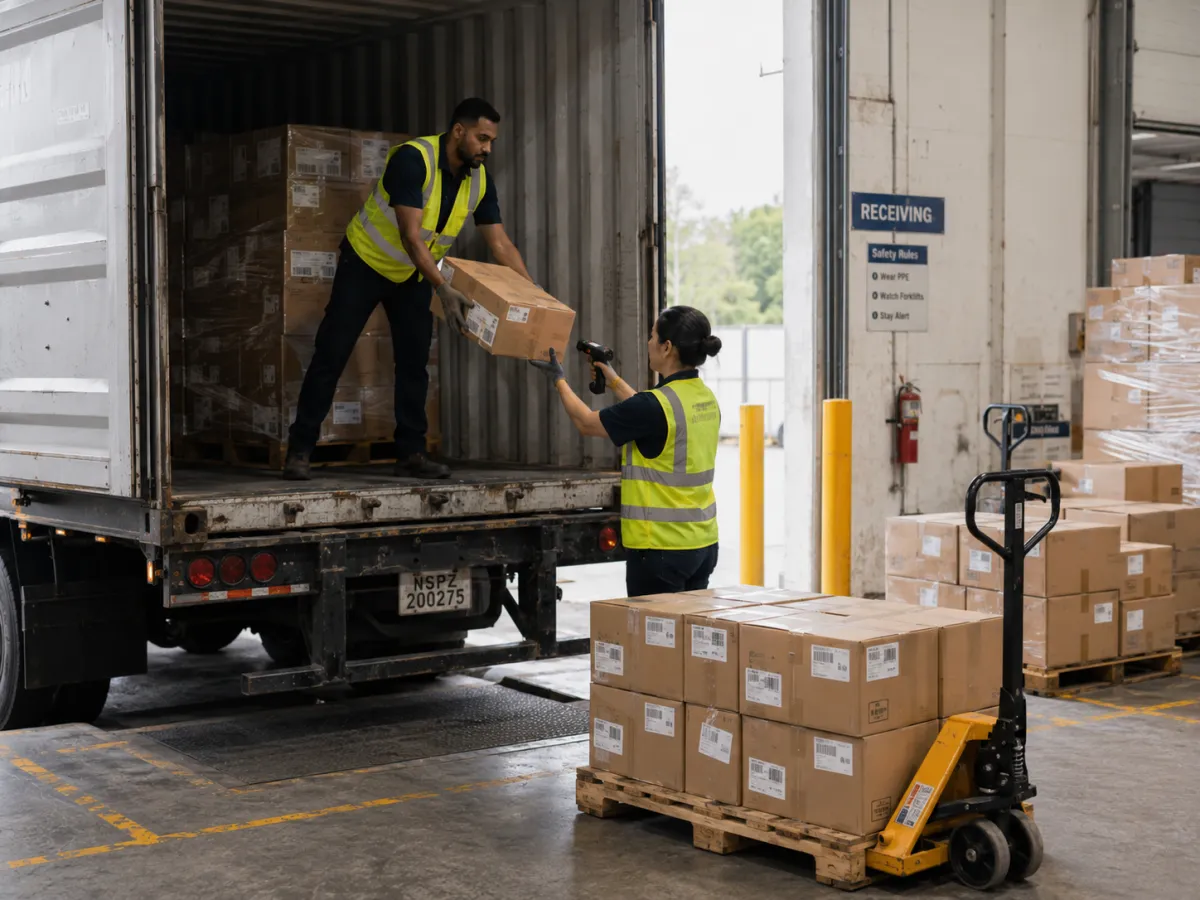
When I ran inventory control for a consumer products brand, month-end meant chasing stock numbers from six outside warehouses and contract manufacturers. One sent a file every week. One had a portal. Two only answered when I emailed and asked. If their numbers were more than a week apart from ours, normal stock movement showed up as "missing" units that weren't missing at all, and getting one clean picture took me most of a week. We didn't make food, so FSMA 204, the FDA's food traceability rule, never applied to us. A covered food company, though, gets 24 hours to hand over its traceability records when the FDA asks. I would have missed that deadline, and not because the records didn't exist.
That's the real test in the rule: can you pull the records together, complete and connected, in a day? It's hard to do when the answers live in someone else's inbox.
What is FSMA 204?
FSMA 204 is the common name for the FDA's Food Traceability Rule, which implements Section 204(d) of the Food Safety Modernization Act. It sets traceability recordkeeping requirements, beyond existing regulations, for anyone who manufactures, processes, packs, or holds foods on the FDA's Food Traceability List.
The Food Traceability List (FTL) is the FDA's roster of higher-risk foods. If a food you make, pack, or store is on it, the rule applies to you unless an exemption covers you. It also applies to products that use a listed food as an ingredient, as long as that ingredient stays in the same form it has on the list, like fresh-cut greens in a bagged salad. Foreign firms producing food for US consumption are covered as well as domestic ones.
FSMA 204 compliance date
Two dates matter. The original compliance date was January 20, 2026. The FDA proposed a 30-month extension in August 2025, and in November 2025 Congress directed the agency not to enforce the rule before July 20, 2028. The extra time is for building the system, not for skipping it.
FSMA 204 requirements: KDEs, CTEs and the 24-hour rule
Firms subject to the rule must keep records of Key Data Elements (KDEs) tied to specific Critical Tracking Events (CTEs), and hand that information to the FDA on request within 24 hours, or within a reasonable time the agency has agreed to.
In practice, four pieces do the work:
Critical Tracking Events are the moments in a food's life the rule cares about, such as initial packing, shipping, receiving, and transformation of a product.
Key Data Elements are the facts you must record at each of those events: which product, which lot, how much, when, and where it came from or went.
The traceability lot code (TLC) is, in the FDA's words, "a descriptor, often alphanumeric, used to uniquely identify a traceability lot within the records of the traceability lot code source." Only three events create one: initial packing of a raw agricultural commodity, the first land-based receiving of seafood, and transformation. Everyone else in the chain passes the existing code along. It's the one number that has to show up on every record, from the first receipt to the last shipment.
The sortable spreadsheet is the part that catches people out. The rule lets you keep the underlying records on paper, but unless an exemption applies, an electronic sortable spreadsheet containing the relevant traceability information must be provided to the FDA within 24 hours of a request during an outbreak, recall, or other threat to public health. A banker's box or a PDF of scans won't do.
Every covered firm also needs a written traceability plan: how you keep the records, how you identify foods on the list, how you assign traceability lot codes, and who to contact with questions about it.
Where traceability data is actually born
Compliance guides tend to treat FSMA 204 as a paperwork problem, but most of the KDEs the rule asks for are captured, or lost, at a specific moment on the floor. The rest arrive on your supplier's paperwork, and you're relying on them to send it.
At receiving, a lot arrives with a lot code on the case or pallet. Either someone captures it, links it to the supplier and quantity, and records where it was put away, or the thread is broken on day one. Even the quantity can become an argument. Some of our suppliers shipped free extra units that were on the packing list but not on the invoice, and receiving had to pick which number to book. We settled on booking what was physically there and costing it off the invoice. Another time, two vendors gave us different counts for the same goods because one counted cartons and the other counted inner packs. The rule asks for quantity and unit of measure at receiving, and that's why both matter. If your dock and your supplier don't agree on what "one" means, the trace record is off before the pallet is even put away.
At putaway and every move after it, the location history either follows the lot or it doesn't. The rule itself tracks location by facility, and a move inside one building isn't a Critical Tracking Event. But if all anyone can tell you is "somewhere in aisle four," someone is going to spend the afternoon looking for it, and bin-level tracking is what makes a recall fast and lets you put a lot on hold. Transfers between our own warehouses were where stock went missing on paper. The purchase order would post, but the transfer order wouldn't be finished for a few days, so the units sat as "in transit" in the ERP. For those days, if anyone had asked where that stock was, the honest answer was "on a truck, probably." You don't want to give that answer with a 24-hour deadline running.
At picking and packing, lots get combined into orders. This is where trace records most often die in manual operations, because the picker knows which bin they pulled from, but the paperwork only knows which SKU shipped.
At shipping, the lot needs to leave a record of where it went. A recall that can say "only these three customers received lot 4471" is an inconvenience. If all you can say is "we shipped that SKU to everyone," every customer who bought it gets a call.
A lot is just a batch of product made or received together and managed as one unit, usually sharing a production or expiry date. Lot traceability means giving each batch its own identity, its own location, and its own history, and keeping that identity attached through every one of the events above.
Why manual traces miss the 24-hour clock
You can do this by hand. It just takes longer than the rule gives you.
A manual trace works backward: pull the receiving paperwork to find when the lot arrived, walk the aisles to find where the rest of it sits, go through pick sheets or shipping logs to reconstruct which orders it went into, then rekey all of it into a spreadsheet and reconcile the quantities that don't add up. Each step depends on people finding, reading, and retyping documents that were never designed to be joined together. Across thousands of cases and dozens of customers, that is days of work. The rule gives you one.
And that's if the numbers agree. At one point our ERP showed about 97,000 units of one component, while the contract manufacturer's count said about 60,000. The gap went back to units that had been scrapped for scuffing and never written off, and for weeks nobody could say which number was right. If a recall had hit that component then, we'd have spent the first day arguing about the count before anyone asked where it went. After that, we asked every warehouse and manufacturer to pull their counts within one to three days of ours, so a gap meant a real problem and not just bad timing.
The 24-hour clock is only the regulator's version of the problem. The same question arrives, with the same urgency, when a major buyer asks for lot-level trace on a shipment, an auditor tests your recall procedure, or a customer reports a quality issue. Many food and beverage buyers now set traceability expectations of their own, ahead of and beyond the FDA's timeline. Whoever asks first, if you're rebuilding lot history by hand, you'll be late.
The food and beverage inventory post makes the same point from the stock side: a quantity on hand isn't enough to act on until you know which lot it is and what happened to it.
What meeting the requirement looks like
More paperwork won't fix this. Scanning each step as it happens will.
Capture the lot by barcode at every CTE. The lot code is scanned at receiving, carried through putaway and every move, and scanned again at picking and shipping, so the record is created as a side effect of doing the work, not as a second job after it. Keep your supplier's traceability lot code exactly as it arrives. If your system gives each receipt its own lot number, that's fine, but store the supplier's code next to it, because that's the one the FDA will ask for. When supplier cases carry GS1-128 labels, the lot is already in the barcode, and lot and serial tracking with GS1 barcodes covers how to capture it.
Use license plates for container-level trace. A license plate is one barcode on a pallet or container that stands for everything on it, lots included. Scan one label and the whole pallet's contents, history, and location move together. For operations that receive and ship in pallets, it is the difference between scanning once and scanning forty times.
Put expiration and rotation control on top of lots. Once lots carry expiry dates, first-expired-first-out rotation and shelf-life checks stop being tribal knowledge and become something the system enforces.
Turn a recall project into a recall query. With lot data captured at each event, "where did lot 4471 go" is a lookup that returns the receipts, locations, and shipments in minutes, already in electronic, sortable form, which is close to what the FDA asks for, as long as the columns match its KDEs.
How to evaluate FSMA 204 compliance software
If FSMA 204 compliance or a buyer mandate is forcing the question, the evaluation is short:
- Does it capture lot codes by scan at receiving, movement, picking, and shipping, or does it expect someone to key them in later?
- Does the lot's location and quantity history survive splits, transfers, and partial picks?
- Can it produce a lot's full history, supplier to customers, as an electronic sortable file in minutes?
- Does it handle expiry dates and rotation, not just lot identity?
- Does it work on the mobile devices your floor already uses?
- Does it keep your supplier's traceability lot code as received, or replace it with its own lot number?
- Can it hold the reference document (the bill of lading, invoice, or ASN number) against each receipt, not just the lot?
That is the standard the rule sets, and July 20, 2028 is when the FDA starts enforcing it. If I were sitting across from a plant manager, I wouldn't start with software. I'd ask them to call their three biggest suppliers of foods on the list this week with one question: when you ship to us, what lot code do you send, and on which document? Then I'd walk down to receiving and see if anyone there can find that code without digging through email. If they can't, that's your project. It won't take two years, but it won't take a week either, and you'll want it working well before the deadline.
Endpoint Cloud does this work at the scan level. If you would rather see it than read about it, book a demo.
FSMA 204 FAQ
Who is exempt from FSMA 204?
The rule has a long list of full and partial exemptions. Full exemptions include small produce farms and other small producers of raw agricultural commodities, shell egg producers with fewer than 3,000 laying hens, small retail food establishments and restaurants, transporters, nonprofit food establishments, and food while it is under the USDA's exclusive jurisdiction, such as meat and poultry. Partial exemptions cover cases like food that gets a kill step, which still needs a record of how you received it. The FDA's exemptions tool walks through which, if any, apply to you.
What foods are on the Food Traceability List?
The list covers higher-risk foods including cheeses other than hard cheeses, shell eggs, nut butters, fresh cucumbers, herbs, leafy greens, melons, peppers, sprouts, tomatoes and tropical tree fruits, fresh-cut fruits and vegetables, finfish, crustaceans, molluscan shellfish and ready-to-eat deli salads. The FDA publishes the full list, with notes on which forms of each food are covered, on its Food Traceability List page.
Is there a delay in the FSMA 204 deadline?
Yes. The compliance date moved by 30 months, from January 20, 2026 to July 20, 2028: the FDA proposed the extension, and Congress then directed the agency not to enforce the rule before that date. The extension changed the date, not the requirements. Once it arrives, covered firms still need to produce an electronic sortable spreadsheet within 24 hours of a request.