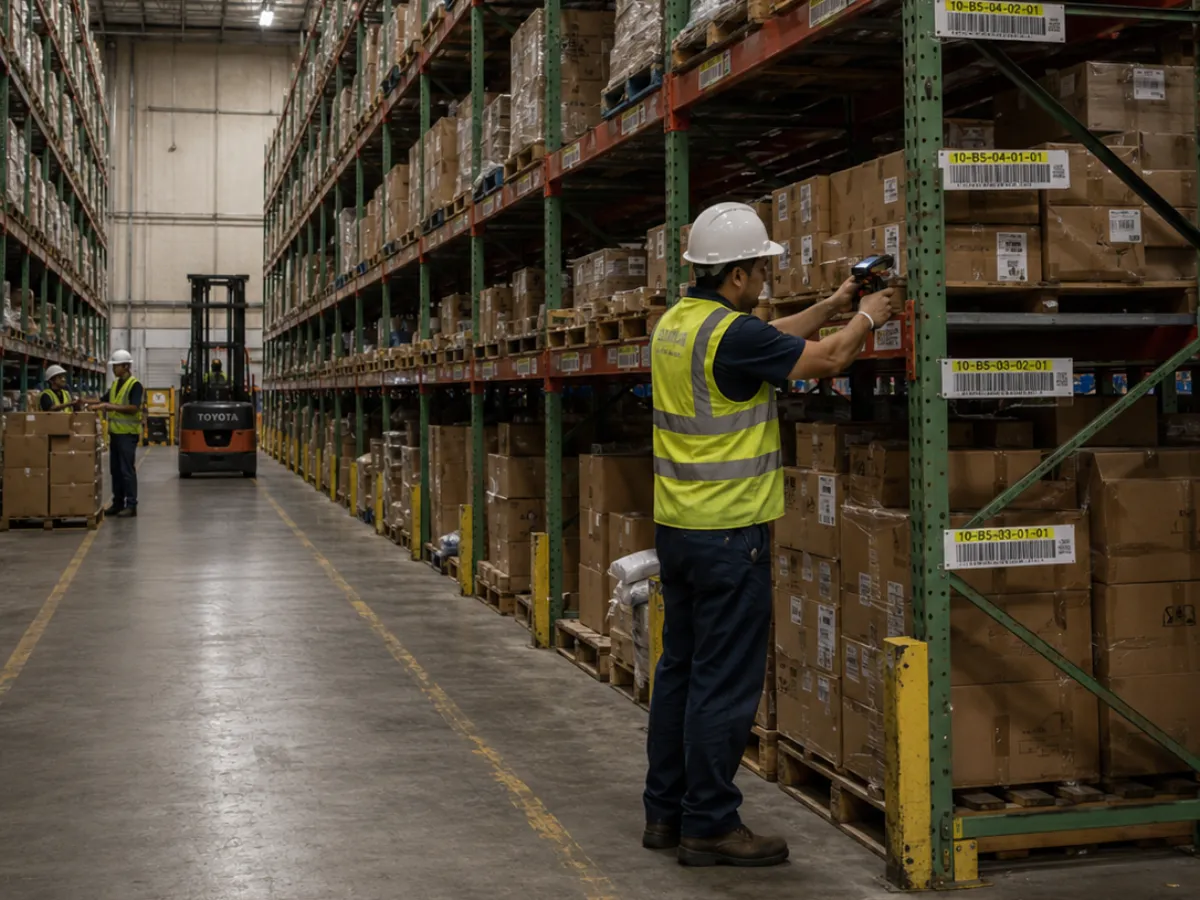
Warehouse automation is everywhere at trade shows right now: robotic picking arms, AI copilots that answer questions about your inventory, and dashboards billed as digital twins. Autonomous mobile robots move pallets around the floor without a person behind the wheel. It's useful technology, and so far it's mostly big companies buying it.
At one company where I ran inventory control, we didn't have a robot or any AI. We had an ERP that synced products to our online store. When someone set up a few new products in the ERP by hand and skipped the item ID the store matched on, the sync stopped updating stock for those products, and nobody noticed for weeks. The software did exactly what it was built to do with the data it was given, and a robot or an AI copilot would have done the same. So for a company with $20 million to $250 million in revenue and 50 to 500 people, the useful question isn't which robot to buy. It's whether your warehouse has AI-ready data yet: inventory records accurate and current enough for a robot or copilot to run on.
What is AI-ready data?
In a warehouse, AI-ready data means inventory records you can act on without checking the shelf first: bin-level counts that match what's physically there, transactions that post in real time instead of at the end of a shift, and lot and serial numbers captured by a scan rather than typed from memory. If a person has to double-check a number before trusting it, an AI tool or robot can't use it either.
What AI and autonomous mobile robots need to work in a warehouse
An autonomous mobile robot (AMR) is a vehicle that moves inventory around a warehouse on its own, guided by sensors and software instead of a fixed track or a driver. That's what separates it from an automated guided vehicle (AGV), which follows a fixed path like floor tape or embedded wire. An AI copilot is software that answers operational questions in plain language or suggests what to do next. Both are sold on removing guesswork, and both depend entirely on data they cannot generate themselves: accurate bin-level inventory counts, real-time task status, and lot or serial numbers that are captured, not assumed.
Skip that foundation and the tools get to the wrong answer faster than the clipboard did. A robot sent to a location where the system shows 50 units on hand, when the floor holds 32, has no way to know the difference on its own. With the AMRs a mid-sized warehouse usually buys first, the ones that lead a person through a pick, the person finds the short, and the bad count turns into a short pick, a stopped robot, and a call to the supervisor.
The data isn't the only thing that has to be ready. AMRs need Wi-Fi across the whole floor, flat floors, and clear aisles, and the robot vendor's first site survey will check all of it. Pallets matter too. We had pallets arrive broken and over-stacked, and someone had to restack them by hand before they could go into racking. A person can work around a pallet like that. A robot can't, so it either refuses the load or moves it badly.
Why most warehouse AI projects stall
Most warehouse AI conversations stall on whether anyone trusts the data, and no amount of artificial intelligence fixes that by itself. A 2015 small-business survey by Wasp Barcode found that 46% of small businesses either don't track inventory or do it by hand. When spreadsheet researcher Ray Panko pulled together field audits of real business spreadsheets, 88% of the ones audited since 1995 had errors. And Gartner predicted in February 2025 that through 2026, organizations will abandon 60% of AI projects that aren't supported by AI-ready data.
Endpoint's own analysis of 1,293 sales conversations with operations leaders turned up the same pattern from a different angle. The problem companies describe most isn't machine learning or autonomous robots. It's basic inventory accuracy, which they typically report at 85% to 92%.
The three fundamentals AI depends on
Three unglamorous things make warehouse AI possible: barcode scanning, directed putaway, and real-time ERP sync.
Barcode scanning replaces a worker's memory and a paper pick list with a scan that either confirms the right item and location or stops the transaction before it goes wrong. Directed putaway tells an operator exactly where a unit belongs based on your own warehouse rules, instead of leaving that call to whoever is holding the pallet.
Those rules have to be set up right, though. We once had a bulk ingredient that the system wouldn't let us post to its location, because the location was set up for finished goods only. It took a couple of hours to find the setting. Directed putaway will follow your rules perfectly, including the wrong ones.
Real-time ERP sync means a scan on the floor shows up in your financial system within minutes, not the next morning after someone keys in a stack of paper tickets.
None of these are AI. They're the plumbing AI and robotics need in place before they have anything trustworthy to work with.
Before and after: what the fundamentals change
| Metric | Without scanning and directed workflows | With them |
|---|---|---|
| Inventory accuracy | 85% to 92% | 99%+ |
| Picking error rate | 3.2% | Under 0.5% |
Figures from Endpoint's field guide, Get AI-Ready From the Floor Up.
That gap, up to 14 accuracy points and a picking error rate more than six times higher, is what an AMR or an AI copilot has to work around if you deploy either one before closing it.
Is your warehouse data AI-ready? A five-point check
Endpoint's field guide uses five criteria for whether a warehouse is ready to pilot AI or robotics:
- Inventory accuracy above 97%, measured by bin-level cycle counts rather than a year-end total, sustained for three or more months.
- Pick error rate below 0.5%, with documented root-cause analysis for exceptions.
- Real-time ERP sync, with transaction latency under five minutes.
- Full lot and serial traceability for any regulated item you handle.
- Dashboard reporting that doesn't depend on manual data compilation.
The lot line is harder than it looks if you assemble anything. For our finished products, tracing a lot was fine. For components, it wasn't, because assembly used up components without recording which lot went into which batch. If a robot or a copilot is going to answer "which customers got this component," that link has to exist first.
Miss two or more of these, and deploying an AMR or an AI copilot doesn't skip the problem. It makes it worse: the robot goes to the wrong bin faster, and the AI recommends a bad decision with more confidence.
Where this fits in a real timeline
Getting from where most mid-market warehouses sit today to that five-point bar falls somewhere between a weekend project and a multi-year transformation. The realistic order: stabilize inventory accuracy first with scanning and validation at receiving and picking, then add a WMS layer with two-way ERP sync and directed workflows, then standardize lot and serial capture and reporting. AI and robotics come after that, piloted selectively, once the data underneath them can be trusted.
What getting ready looks like
This is the part that doesn't show up at trade shows. It looks like barcode scanning on receiving and picking that catches a mispick before it ships, not after a customer complains. It also looks like directed putaway and real-time sync back to your financial system, so the number your ERP shows at 9 a.m. matches what's on the shelf.
That's the layer Endpoint Cloud is built around: barcode scanning at receiving and picking, directed putaway, license plate tracking, lot and serial tracking, and dashboards that update as the floor moves. Endpoint doesn't sell the robot or the AI copilot; it builds the groundwork that makes either one worth buying later.
For the full five-point readiness check and how to close each gap, Endpoint's field guide Get AI-Ready From the Floor Up walks through it in more depth. And if digitization and digitalization are both on your radar this year, that distinction is worth a read alongside this one.
If a plant manager asked me whether to book the robot demo, I'd say go ahead, but do one thing first. Pick 20 bins at random tomorrow morning, count them, and check the counts against what the ERP says. Then scan something and time how long it takes to show up in your financial system. If any of those 20 bins is off, or the scan takes until tomorrow, you'll spend the demo watching a robot drive to the wrong place. Get to AI-ready data first. The robot will still be for sale.