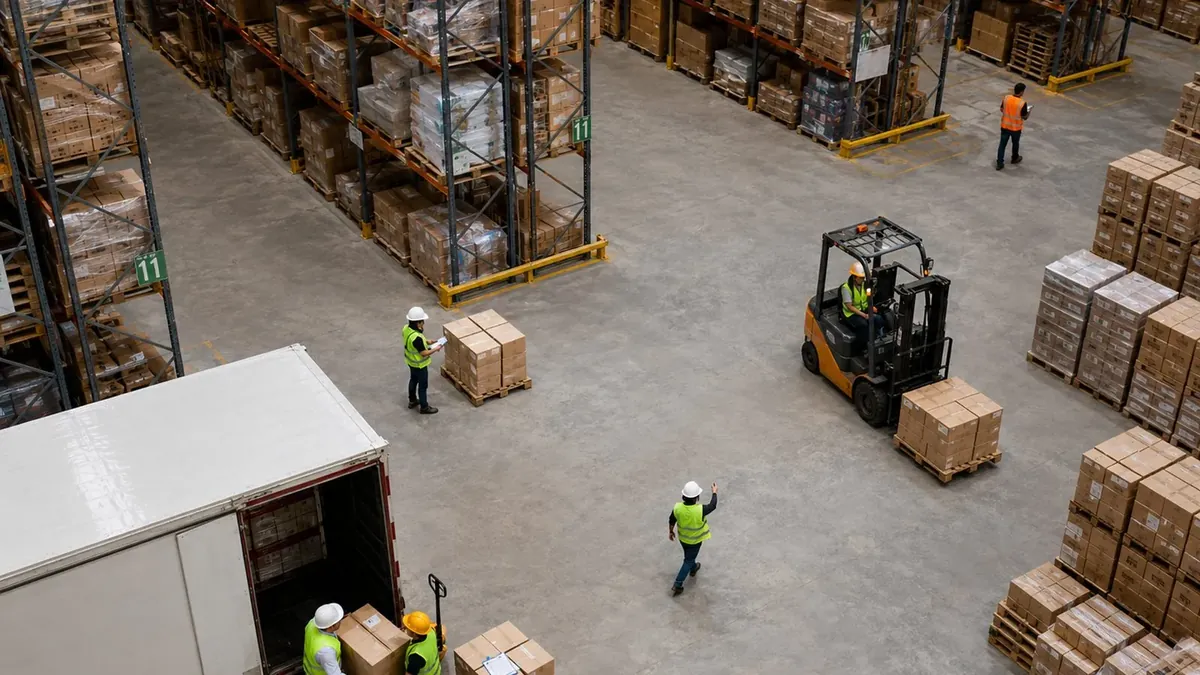
Your financial system already has both warehouses set up. The codes exist, the locations are configured, every screen has a site field on it. And the numbers are still wrong often enough that somebody drives between buildings to look at a shelf.
Multi-warehouse inventory management is the work that starts after that configuration screen. Knowing what's actually on the shelf at each site is a different job from having a field for it, and it's the one that decides whether the second building makes you faster or just gives you two places to lose things.
What the second location buys you
A second warehouse usually shows up for a good reason. Orders start arriving from a region the original building can't reach in two days, freight costs climb, and someone runs the numbers and finds it's cheaper to hold stock near the customer than to ship it across the country. That's growth, not overreach. What catches teams out is how much changes the moment inventory lives in two places instead of one.
Shipping from whichever site sits closest to the customer takes a day or two off transit and real money off the freight bill. It also gives you somewhere to put stock when the first building runs out of rack, which is often the reason the conversation started in the first place. And when a storm closes one facility or an inbound container sits at anchor, you have another shelf to pull from instead of telling a customer their order is on hold.
What gets harder
Every problem below traces back to the same thing. Your inventory record now has to be right in two places at once, and nothing about that happens on its own.
Keeping both sites stocked. Attention drifts toward the busier building. The quieter site runs down slowly, nobody notices because the company-wide on-hand number still looks healthy, and the shortage announces itself as an order that can't ship.
Getting orders to the building that has the stock. Customers deal with one company and have no idea which of your sites holds the item. When an order lands on a warehouse that's out, you either transfer it, which costs time and freight, or split the shipment, which costs margin and usually irritates the customer.
Reconciling stock that's between sites. A transfer that has left one building and hasn't been received at the other belongs to neither count. If nobody owns that gap, it turns up at year end as shrink that isn't really shrink.
Multi-warehouse, multi-location, multi-site: one problem, three names
Ask three operators what this is called and you can get three answers. Multi-warehouse is the usual word in distribution. Multi-site turns up in manufacturing, where the other building is a plant. Multi-location inventory management is what you hear from companies that also run a retail counter or a service depot. The job underneath all three is the same: one accurate stock record across buildings that are physically apart.
Where the words do point at something real is staffing. A warehouse normally has a receiving function and someone whose job includes the count. A stockroom behind a service counter, or a staging area at a plant, often has neither, and stock moves in and out of it without anyone scanning anything. Those locations are usually where the company-wide number first goes wrong, and they're worth bringing onto a system earlier than their volume suggests.
Put every location on one system of record
This is the technique the others depend on. If each building keeps its own count in its own spreadsheet, everything downstream is guesswork.
Having warehouse codes in the financial system isn't the same as having one system of record. The ERP knows what was received because somebody keyed it in, usually in a batch, usually hours after the pallet landed. What it doesn't know is where that pallet went next. A system with location-level detail closes that second gap: on hand by bin at each site, updated as the work happens, and a transfer that carries a status instead of living in an email thread. It also means the answer to "do we have twelve of these anywhere" takes seconds instead of two phone calls.
The practical test is whether someone standing in the aisle with a handheld sees the same number a customer service rep sees on their screen. If those two numbers can disagree, you don't have one system of record yet. That gap is what Endpoint Cloud is built for. It defines zones, aisles, racks and bins, tracks every unit in every location, and captures receipts, moves, counts and picks in real time rather than leaving them to be reconciled later.
Lay out each building around what it actually ships
The two warehouses probably don't ship the same mix, so they shouldn't be laid out the same way. Pull the last few months of order lines per site and put the fastest movers closest to the pack and ship area at each one. Slow movers can go up high and far back.
Label bins and shelves clearly enough that someone who has never worked that aisle can find the location from the pick list without asking. That's the difference between a new hire being productive on day two and being productive in month two.
For sites that bring in seasonal team members during a peak, post a printed map of the layout at the dock door and at the end of each aisle. It costs nothing and it saves a surprising number of walking miles.
Bring suppliers into the same system
Once purchasing can see supplier availability, pricing, and lead time next to the on-hand figure for each location, reorder decisions get much less dramatic. You can see that the item is short at the east warehouse, that your primary supplier is three weeks out, and that a second supplier can be there in five days, all before anyone has picked up the phone.
Lead time is the field people skip and then regret. A reorder point calculated without it will always be wrong at the site that's furthest from the supplier.
Count by scanning, not by walking the aisles with a clipboard
Nobody is doing a full physical count of two buildings often enough to keep the numbers honest, and the annual count that does happen tends to get pencil whipped when the clock runs out.
Scanning stock as it's received updates the record at the moment it lands, which is the only time anyone is genuinely certain what's on the pallet. From there, cycle counting a slice of locations each week keeps accuracy up without shutting anything down. Count the fast movers and the high-value items more often than the rest, since those are where an error costs you an order.
The gain compounds across sites. When receiving is scanned at both buildings, a transfer stops being a leap of faith and becomes a record you can check.
Getting the order to the building that has the stock
Two sites turn every order into a routing question. At first a person answers it. Someone in customer service knows the east warehouse usually has the fast movers, so that's where the order goes, and when east turns out to be short the order gets split or transferred.
A transfer isn't free. Once stock leaves the dock it's committed, in motion and unavailable to both sites, and the freight on an inter-site move comes out of the same margin the second warehouse was supposed to protect. A split shipment pays for packaging and freight twice and arrives in two boxes on two days, which the customer notices.
You can't avoid either one entirely. You can make them rare, by knowing at the moment the order is taken what each site can actually ship today. That depends on the location record being right, which is why the counting comes first. Routing rules built on numbers nobody trusts get overridden by hand soon enough, and then you're paying for the rules and still making the phone calls.
Common questions about running inventory across multiple warehouses
How do you track inventory across multiple warehouses?
Track it at the location, not at the company. That means every receipt, move, pick and count is recorded against a specific site and a specific bin inside that site, at the moment it happens, usually by scanning a barcode. A company-wide on-hand figure is just the sum of those records, so it's only as good as the worst-run site feeding it.
Is it better to hold stock in one central warehouse or several regional ones?
One central warehouse is simpler to run and much simpler to count. Several regional ones ship faster and keep you trading when a single site goes down. What usually settles it is transit time: once a meaningful share of your orders can't reach customers inside the window you've promised, the freight savings and the orders you stop losing start to pay for the second site. The cost on the other side is safety stock, because every site carries its own.
How do companies get orders to the right warehouse?
By hand, to begin with. Customer service picks the site they believe has the stock, and that works until the two sites stop agreeing with the record. Automating it means routing on live on hand by location and transit time to the customer, and it's only worth doing once the counts are trustworthy. A routing rule fed by a wrong number just makes the wrong decision faster.
Do you need a WMS to run more than one warehouse?
Not on day one. A second site can run on the ERP alone while volume is low and the same few people work both buildings. It stops working when the count at one site is being corrected from memory, when transfers go missing between the two, or when nobody can say what's available to promise without walking the floor. When that happens, see what warehouse software adds to your ERP.
Where to start
If you're standing up a second location now, get the single system of record in place before the first pallet moves. Retrofitting it after both buildings have developed their own habits is considerably more work than doing it up front.
If you're already running two sites and the numbers don't agree, start with scanned receiving at both, because everything else you'd like to fix depends on the incoming count being right.