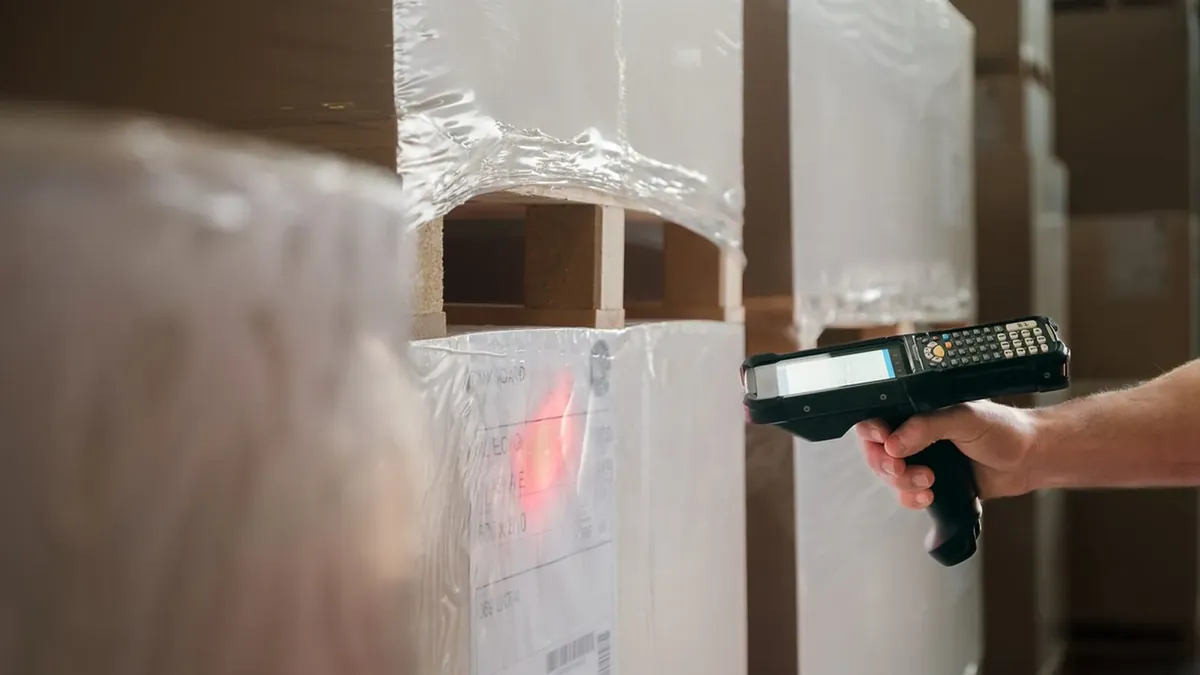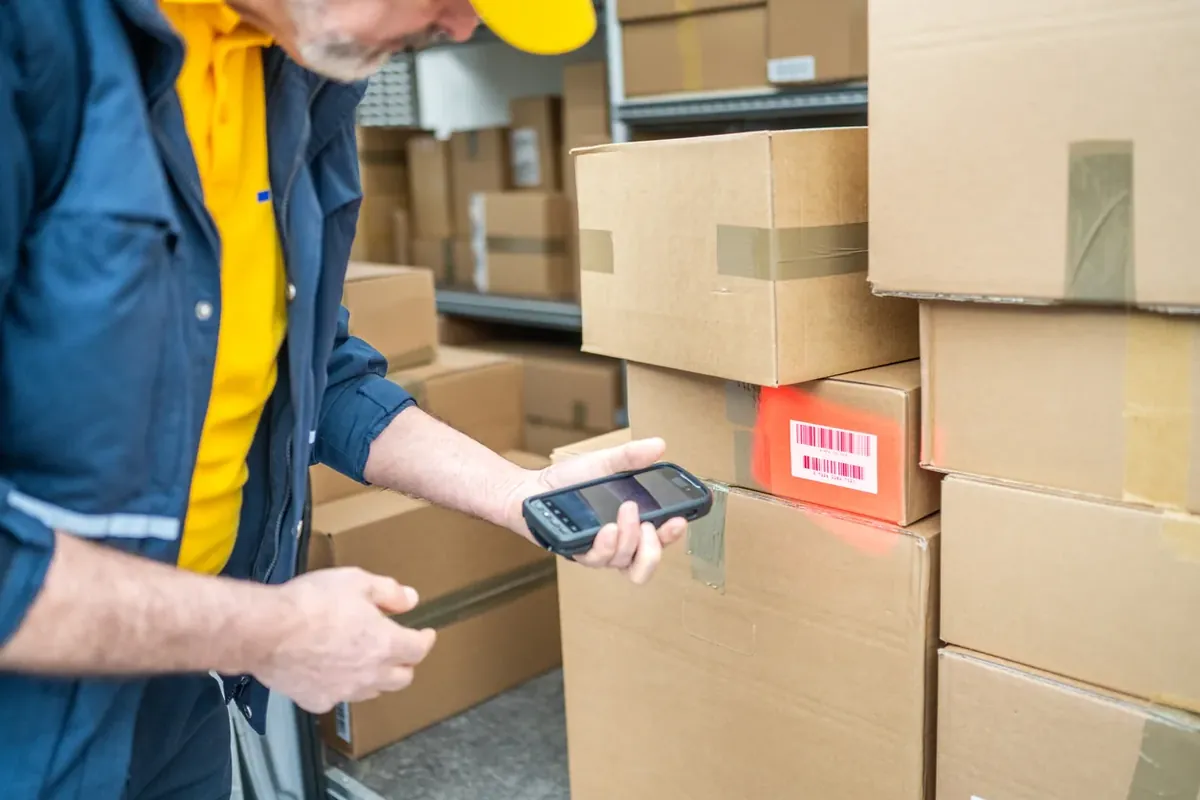
Sooner or later somebody asks why your warehouse isn't on RFID yet. Usually it's a customer. Sometimes it's your own boss, back from a trade show with a bag of brochures. If you already scan barcodes, the RFID vs barcode question can make your whole plan sound out of date.
I've been on the receiving end of it. At a three-site manufacturer and distributor where I ran operations, a large customer asked about tags, so we piloted RFID at the dock doors. Part of that pilot was worth doing. Part of it never touched our real problem.
The short answer: RFID reads many tags at once, by radio, without seeing them. A barcode gets read one label at a time, in plain view.
If you're looking at RFID because your ERP and your shelves don't agree, ask yourself something else first. Are your labels slow to read, or are some moves never getting recorded? Those have different fixes. New to scanning? Start with our posts on warehouse barcode systems.
What is RFID?
RFID (radio frequency identification) is a wireless system of tags and readers. A reader's antenna sends out radio waves, and a tag on an item answers with its identity and sometimes more data. The tag doesn't have to be in view to be read. That's the whole difference from a barcode, and it's more or less how the FDA describes RFID.
How RFID works: tags, readers and passive vs active
GS1 US breaks an RFID system into four parts: the tag, the antenna, the reader and the host system the reader reports to.
The reader is the part vendors like to show you. It can be fixed to a wall or ceiling, carried in your hand, or built into a walk-through unit. Whatever it picks up goes to the host system, and the host system is what turns a read into a record. In most buildings I've worked in, that meant the warehouse software and, behind it, the ERP.
Passive vs active RFID comes down to power. Passive tags have no battery, so the reader's signal powers them. Active tags carry their own. GS1 calls passive UHF (ultra-high frequency) tags, also known as RAIN RFID tags, the most widely implemented tags in its industries.
Under GS1's RFID standards, a tag holds an Electronic Product Code (EPC). An EPC can encode the same GS1 identifiers a barcode can carry, such as a serialized GTIN: a GS1 item number plus a serial number for that one unit.
GS1 says passive UHF tags can be read at well over 10 meters without line of sight. Your building gets a vote on that. When a vendor quotes you a read range, ask which reader and which tag they tested, and what the tag was stuck to.
RFID vs barcode: the differences side by side
| Barcode | RFID | |
|---|---|---|
| How it's read | A scanner needs a clear view of each label, one at a time | A reader picks up tags by radio, without line of sight, many at once |
| What it identifies | A value your system ties to a part number or bin, or a GS1 identifier such as a GTIN; GS1 barcodes can add lot and serial numbers | An EPC, which can hold the same GS1 identifiers |
| Cost per item | A printed label, which you may already be paying for | A tag (chip and antenna) on every item or case you tag |
| Hard spots | Labels the scanner can't see | Metal and liquids near the tag, though tags made for them now exist |
| What you need | Labels, a printer, handheld scanners, and software that records the scans | Tags, readers and antennas, and software that records the reads (the host system) |
| Strongest at | Confirming one item against one task | Reading a full pallet or an aisle in one pass |
The barcode vs RFID table covers how each one reads, and that's all it covers. A scanner doesn't know what an item is. As our guide to how barcodes work puts it, a record ties the value it reads to a part number, a lot or a bin. Whether the system expected that pallet, and where it should go next, is the software's job with either one. On the barcode side, that's what warehouse software adds to your ERP.
The data can line up, too. If you already print lot and serial numbers in GS1 barcodes, an EPC can carry the same GS1 keys.
About those hard spots. A 2005 University of Kansas study found that UHF tags struggled near water and metal, and item-level tags more than case-level ones. That was 2005. GS1 US notes that tags made for metals and liquids now exist.
Where RFID earns its keep in a warehouse
Where I've seen RFID in warehouse work pay off, it was reading in bulk or reading what nobody could see. Sometimes it isn't your decision at all.
The dock is the obvious place. GS1 US says tagged cases and cartons can be processed without line of sight, so a fixed reader at the door can read the tagged cases as the pallet goes past, including cases stacked inside where nobody can see a label.
Counting is the other. GS1 US describes auditing stock levels with handheld readers, which in a warehouse means walking an aisle with a reader instead of scanning bin by bin. The barcode version of the same job is cycle counting with a barcode scanner, and it's how most of the buildings I've run did their counts.
Then there's the customer who requires tags. Apparel was one of the first industries to adopt RFID for inventory management, according to GS1 US, and a customer may ask you to tag what you ship them. In our pilot, the outbound lane for the customer that required tags is where the tags were worth having. That customer had a real reason for asking, and I'd tag that lane again tomorrow.
If one of these is your problem, a plain primer from GS1 US covers RFID inventory management. If you mostly want more data on the label, check where 2D barcodes already do the job first.
Where barcodes are still the better fit
GS1 US promotes RFID, and it still says RFID is not always the right solution and should be judged on your specific needs. Fair enough.
Cost is where I'd start. Every item, case or pallet you want to read needs a tag, and a tag is a chip and an antenna. GS1 US also says getting an RFID inventory system to work properly takes time, effort and money, and it expects that to pay back when it's done right. A barcode goes on a label you're probably printing already. If much of what you store is metal or liquid, add a round of tag testing before you price anything.
At the bin, the job is one item against one task. The device compares the barcode on the box with the line on the order and accepts it or refuses it. That's what a scan catches at the bin. Reading everything in range at once adds very little there.
RFID also doesn't touch the problem we actually had. On our pilot, pallets read on the way in at the dock doors, which was impressive, and the counts inside the building drifted anyway. The tags told us a pallet had arrived, and nothing told the system where it went next, because nobody was recording putaway moves.
More barcode labels wouldn't have fixed it either. If your counts drift because receipts get keyed in late or putaway happens from memory, the fix is recording each move when it happens, and barcodes can do that. On pallets, license plate tracking lets you track a pallet from the dock door through putaway with a single scan.
Questions to ask before you add RFID
I'd want these answered before signing anything.
- What problem are you solving? Slow reads, missed reads or moves nobody records. Only the first two are reading problems, and in my experience the third is the one that shows up most.
- What will you tag, and who puts the tags on? Items, cases or pallets. You or your suppliers. Those are very different conversations.
- How much of what you store is metal or liquid? Test tags on your actual products, in your actual racks.
- Do your warehouse software and your ERP accept RFID reads, and where do the reads post? Ask the vendor to show you, on screen, where a read lands.
- Is a customer asking for it? For which shipments, and who pays for the tags on that lane? If one customer wants tags, you can tag that customer's shipments and keep the rest of the building on barcodes.
- Would barcode license plates on pallets get you most of the speed for less? Price both.
Whatever you pick, the floor will run slower while people learn it. Plan for that. When we rolled out handheld scanners, the first complaint was that scanning was slower than writing. It was, for about two weeks, and then nobody wanted to give the scanners back.
Common questions about RFID and barcodes
Is RFID outdated?
No, though it isn't new. The US Department of Homeland Security notes RFID has been commercially available in one form or another since the 1970s, in car keys, employee identification and highway toll tags. GS1 still maintains RFID standards today. Whether it fits your warehouse is a separate question, and it mostly comes down to whether you need to read many items at once.
Is RFID replacing barcodes?
Not in GS1's standards. GS1 maintains both and publishes guidance on using them together. For reusable pallets, its 2010 pallet tagging guideline recommends, without requiring it, that the pallet's ID also appear in a barcode or human-readable form, and in the trial it describes, the barcode served as the backup. Our pilot pallets kept their barcode labels too.
What are the downsides of RFID?
Cost and setup, mostly. You need a tag on everything you want to read, plus readers, antennas and the work of getting the system running. Metal and liquid near a tag can cause read problems, though tags made for metals and liquids now exist.
How much does an RFID inventory system cost?
I haven't seen a neutral, current figure for what an RFID inventory system costs, and I wouldn't trust one that didn't start from your tag volume. Here's how I'd rough it out. Multiply the units you'd tag a year by the tag price you're quoted, then add readers, antennas, software changes and setup time. Price barcode license plates for the same job and compare the two.
Which is better, NFC or RFID?
They do different jobs. NFC (near field communication) is a short-range form of RFID, and GS1 lists it among RFID tag types. The NFC Forum describes it as working at 13.56 MHz with a typical range of up to 2 cm. That's fine for tapping one item and no use for counting a pallet. Every warehouse RFID pitch I've sat through was about passive UHF tags.
Can RFID tags be read through boxes?
Yes. GS1 US says tags can be read even when they aren't visible, such as inside containers or stacked items, which a barcode can't do. What's inside the box still matters if it's metal or liquid, so test tags on your own product, packed the way you ship it.