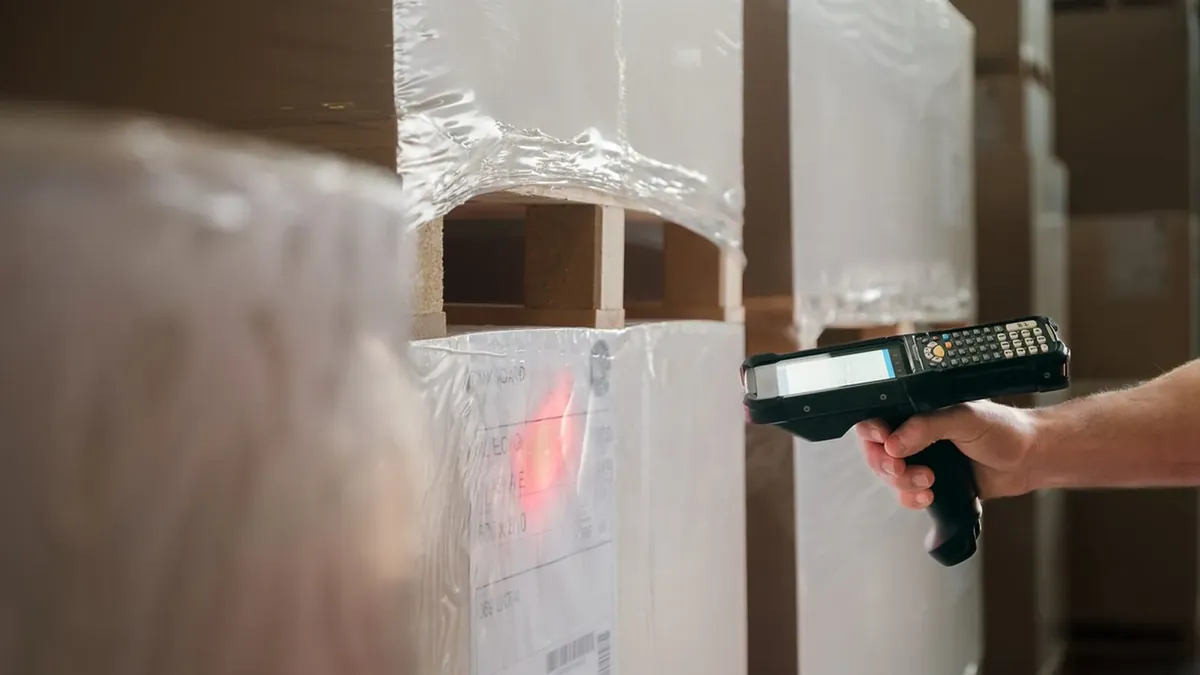
The barcode on a can of soup has looked roughly the same since the 1970s, and the reason it's still there is that it works. It costs nothing extra to print, and every checkout lane in the country can read it. What's changing isn't that the UPC is being retired. It's that a second, denser code is turning up alongside it, and by the end of 2027 the scanners on the other end are expected to read both.
What a UPC actually holds
A U.P.C. is a GTIN and nothing else. Twelve digits identifying the product, with no room for a lot number, an expiration date, a serial, or a link. Everything else your systems know about that item gets looked up from the GTIN in a database somewhere.
That's fine right up until the thing you need at the moment of the scan isn't in the database yet, or isn't in the same database. Lot and expiry are the everyday examples. A case of yogurt carries a GTIN in the barcode and a lot code printed as human-readable text next to it, so somebody keys it in, or doesn't.
Linear codes that carry more do exist, and warehouses have used them for years. GS1-128 encodes application identifiers alongside the GTIN, which is how a shipping label carries a batch number and a date in scannable form. It's also physically wide, which is why it lives on a pallet label rather than on a retail package.
Two-dimensional codes solve the width problem. A GS1 DataMatrix or a QR Code encodes across both axes, so capacity goes up by orders of magnitude in a symbol small enough to fit on a vial or a produce sticker.
Sunrise 2027
GS1's Sunrise 2027 initiative is why this is moving on a schedule instead of one product at a time. GS1 US describes it as a global transition from 1D UPC barcodes to 2D barcodes such as QR Codes, with retail point-of-sale systems expected to read those codes and pull the GTIN out of them (GS1 US, What is GS1 Sunrise 2027?).
Two things about it are worth being precise on. It isn't law. It's an industry milestone driven by retailers and the standards body, which means it arrives as a customer requirement rather than as a regulation. And it isn't a replacement date. The guidance through the transition is dual marking, so the EAN/UPC stays on the package and the 2D code goes next to it, and the item scans wherever it ends up.
For a manufacturer or distributor, the practical version of this is that a retail customer's labeling spec is going to change, and it'll show up in a purchase order or a routing guide before it shows up anywhere else.
Where 2D codes already do real work
None of this is new inside the four walls. 2D codes have been standard for years anywhere the label has to be small or the surface is hostile.
- Direct part marking. A DataMatrix laser-etched or dot-peened into metal, read by an imager. The mark outlives paint, heat, and years of handling, which is why it's normal on tooling, castings, and circuit boards.
- Serialized pharmaceutical packaging. A GS1 DataMatrix carrying GTIN, serial, lot and expiry on a carton with no room for anything wider.
- License plate labels. One code on a pallet or tote that resolves to a whole nested list of contents, so a single scan moves the lot rather than every carton in it.
RFID solves a different problem
RFID gets discussed in the same breath as 2D codes and it probably shouldn't be. A barcode needs line of sight and one symbol at a time. An RFID tag doesn't, which is why its strongest uses are the ones where the count matters more than the individual read: a dock portal that reads a full pallet as the forklift drives through, a cycle count done by sweeping an aisle with a handheld reader, apparel inventory where every unit is tagged at the source.
What has kept it from displacing printed codes is cost per unit and physics. A printed symbol costs effectively nothing and a tag doesn't, and metal and liquid detune RF, which describes a great deal of what sits in warehouse racking.
What this means for the scanners you already own
This is the part that lands on a budget. A laser scanner sweeps a line across a symbol and can only decode a linear code. An imager takes a picture and decodes whatever is in the frame, which means it handles 1D and 2D both. Handhelds bought recently are mostly imagers already, so the exposure tends to be older laser units, fixed-mount scanners on a conveyor, and whatever is bolted to the forklifts.
The label side is easier than people expect. A thermal transfer printer doesn't care whether it's printing a linear code or a DataMatrix. The work is in the label template and in whatever populates the extra fields, not in the printer.
That's the real constraint here, and it always has been. A code that holds more data is only worth printing if something downstream reads the extra fields and does something with them. That's a systems question rather than a printing one, and it's the same question that left the barcode itself sitting unused for twenty-five years after it was patented.