A customer calls about a bad batch. To answer, you need two lists: every material lot that went into it, and every customer who received product made from those lots. Manufacturing traceability decides whether you can build those lists from your records, or have to rebuild them from paper and memory.
Most guides to traceability in manufacturing follow the production line. This one follows the material as well, from the receiving dock to the shipping door. For more on the topic, see our posts on traceability and compliance.
What is traceability in manufacturing?
Traceability in manufacturing is the ability to follow a product and its materials through every step of making and shipping it. For each finished lot or serial number, you can say which material lots went into it, when and where it was made, where it was stored, and which customers received it.
Forward and backward traceability
Backward traceability starts with a finished product and works back to the material lots and suppliers behind it. You use it to find a cause.
Forward traceability starts with a material lot and works out to every finished lot that used it and every customer who received one. You use it to find the product.
A recall needs both. If a supplier tells you a resin lot was contaminated, the forward trace shows which work orders consumed it and who got the output. If a customer reports a failure, the backward trace shows which supplier lots to look at.
A second split you will see is internal and external traceability. Internal covers what happens inside your plant. External covers the hand-offs with suppliers and customers. Your records have to connect the two at receiving and at shipping.
Three levels of traceability
How deep you trace depends on what you make and who asks.
| Level | What you record | Typical fit |
|---|---|---|
| Item | Which product and how many | Stock with no lot or serial requirement |
| Lot or batch | Which batch, with its dates and quantities | Food and beverages, chemicals and formulated products, many purchased components |
| Serial | Each individual unit | Electronics, machinery, medical devices and other high-value assemblies |
Many plants use more than one level: lot for raw materials, serial for finished units. Our industry pages cover what that looks like in food and beverage, chemical, industrial, electronics, medical device and aerospace and automotive manufacturing.
Why traceability matters in manufacturing
The practical reason is scope. If you can say that only three customers received an affected lot, a recall means three calls. If all you know is that the item shipped, every customer who bought it gets a call.
The second reason is root cause. When defects cluster, a backward trace shows whether they share a supplier lot, a machine or a shift, so you fix the cause instead of the symptom.
Regulators set the depth in some industries. For foods on FDA's Food Traceability List, the Food Traceability Rule requires records for each Critical Tracking Event and an electronic sortable spreadsheet within 24 hours of a request during an outbreak or recall. FDA will not enforce it before July 20, 2028, and our FSMA 204 compliance guide covers the details. For medical devices, FDA's Unique Device Identification system requires a unique device identifier on device labels and packages. Elsewhere, the requirement often arrives in a customer contract or a certification audit.
Where traceability breaks on the floor
Most manufacturers have lot and serial fields in the ERP. The trail breaks at the moments when material moves and nobody records which lot moved.
Receiving
The supplier's lot code arrives on the case label or the packing slip. If it is written down and keyed in later, or replaced with an internal number and not stored next to it, the backward trace stops at your dock.
Storage and moves
A lot that sits in one bin is easy to find. A lot split across three bins, with one pallet moved to a staging lane, is not, unless each move is recorded. Pallets that get broken down lose their labels.
Material issue
This is where genealogy is made. When a picker takes material to the line and nobody records which lot went to which work order, the finished lot has no parents. The ERP shows the material as consumed but cannot say by what.
Work in progress and finished goods
The finished lot or serial number has to be assigned when the work is done and tied to the material lots issued to that work order. Rework and partial completions are where this most often gets skipped.
Shipping
If the pick and the packing slip record only the item, the forward trace ends at your door. The lot or serial number has to be captured at the pick or at the pack station.
Manual versus scanned traceability
Paper travelers and handwritten lot logs can work at low volume. The trouble starts when lots split, volumes rise and the person who knows where everything is goes on vacation. A manual trace means pulling receiving paperwork, production records and shipping logs, then retyping them into one spreadsheet. Across many lots and customers, that is days of work.
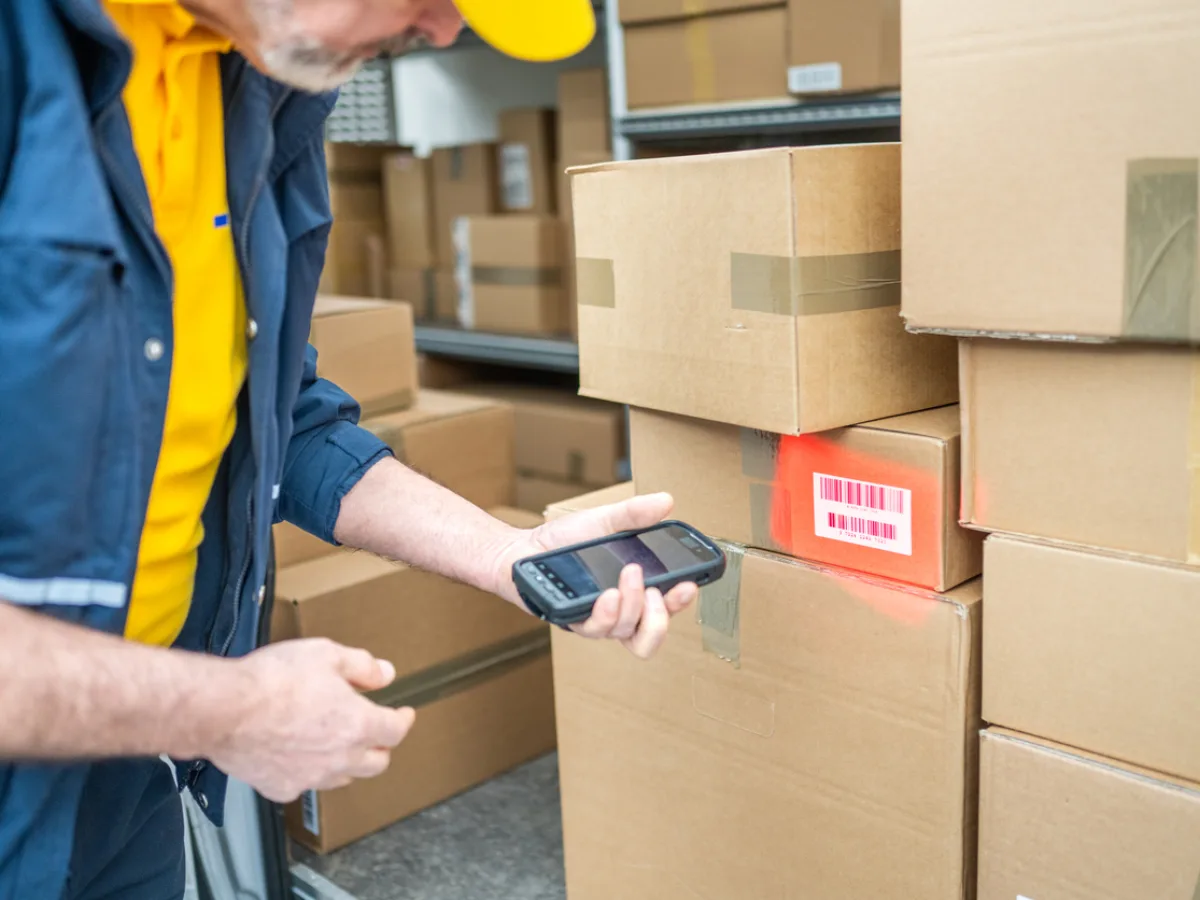
With barcode scanning at each step, the record is created while the work is done. The receiving clerk scans the supplier's label, the operator scans the lot issued to the work order, the picker scans the lot that ships. The trace then becomes a report rather than an investigation.
How to improve traceability in your plant
- Decide the level for each item. Set lot or serial tracking on each item in the ERP before stock moves. In some ERPs you cannot change an item's tracking setup once it has transactions.
- Capture the supplier's lot at receiving. Scan it, and keep the supplier's code next to any number you assign. If suppliers use GS1-128 labels, the lot and expiration date are already in the barcode, as our post on lot and serial tracking with GS1 barcodes explains.
- Record every move. Scan bin-to-bin transfers, and label pallets so one scan moves everything on them.
- Record material issue against the work order. Scan the lot at the point of use, not from the bill of materials afterward.
- Tie finished lots to their inputs. Assign the finished lot or serial at completion, against the same work order.
- Capture the lot at shipping. Scan it at the pick or at the pack station.
- Test it. Pick a real lot and trace it both ways, timing how long each direction takes. Where it stalls is your next fix. Our post on running a mock recall walks through the exercise.
What software tracks manufacturing traceability?
There is rarely one system. The ERP holds the item master, costs and the official lot and serial records. A manufacturing execution system, where you have one, records what happens at each station. Warehouse and shop floor scanning software records the material moves between them: receiving, storage, issue to production and shipping.
If you run Acumatica, Endpoint for Acumatica posts material issue, labor and moves to Acumatica production orders, with a step-by-step record of who did what, and where, at every operation. Its Production module needs Acumatica Manufacturing Edition.
Whatever you use, pick a lot you shipped last month and time how long the two lists take.